
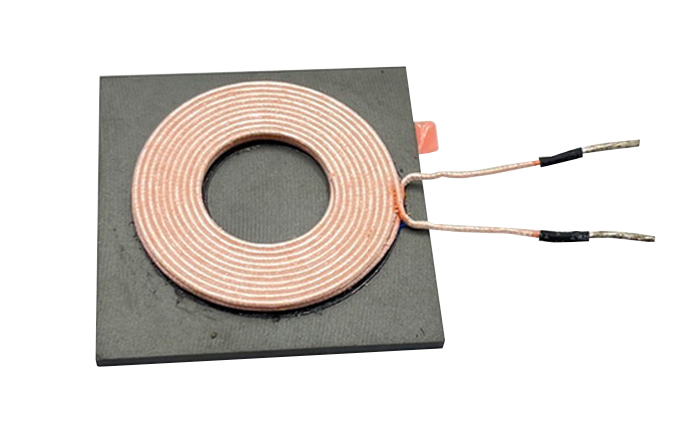
Wireless charging coils enable energy transfer between a transmitter and receiver without physical contact. These systems utilize electromagnetic induction or resonance principles to transmit power through oscillating magnetic fields. Key advancements include:
Historical Evolution
1890: Nikola Tesla conducted wireless power transmission experiments using resonant inductive coupling.
2007: MIT researchers achieved 2.7m wireless power transfer using resonant coils.
2014: Dell integrated resonant charging into laptops, marking its commercial use.
2017: Apple’s iPhone adoption of Qi wireless charging accelerated mainstream adoption.
Technical Principles
Electromagnetic Induction: Transmitter coils generate alternating magnetic fields, inducing current in receiver coils. Efficiency reaches 70–90% for short distances (<5mm).
Resonance Coupling: Coils tuned to identical frequencies enable energy transfer over longer ranges (up to 1m) with 40–70% efficiency.
Performance Advantages
Lower energy loss compared to wired charging (e.g., 15% efficiency improvement for smartphones).
High compatibility with Qi-standard devices (e.g., smartphones, earbuds).
Applications
Consumer Electronics: Smartphones, wearables (e.g., Qi-based charging pads).
Automotive: Wireless EV charging pads (e.g., BMW’s 3.2kW systems).
Industrial: Medical implants (e.g., pacemakers) and IoT sensors.
Challenges
Distance limitations (e.g., Qi requires<5mm contact).
Heat generation from metal objects near coils.
Coil Types
Low-Power: Copper coils for smartphones (e.g., 5W charging).
High-Power: Ferrite-core coils for EVs (e.g., 11kW systems).
Future advancements focus on dynamic resonance tuningand multi-device charging.
PREV:What is a Wireless Charging Receiver Coil?
NEXT:Common Coil Winding Characteristics and Application Scope





 Home
Home