
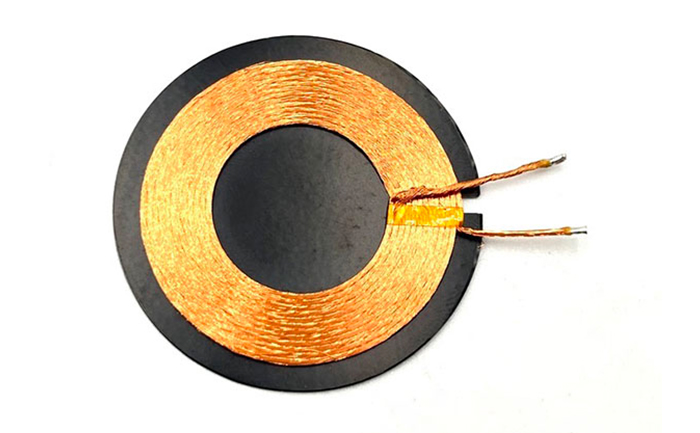
Wireless charging transmitter coils are core components of wireless charging systems, responsible for efficiently transmitting electrical energy to receiver devices via electromagnetic fields. Below is a detailed explanation from technical principles, structural characteristics, material selection, design challenges, and typical applications:
1. Working Principles
Based on electromagnetic induction (Qi standard) or magnetic resonance:
Electromagnetic Induction: The transmitter coil generates an alternating magnetic field when AC power is applied. The receiver coil induces current through Faraday's Law, which is rectified to charge the device.
Magnetic Resonance: Transmitter and receiver coils resonate at the same frequency, enabling mid-range energy transfer (common in electric vehicle charging).
2. Structural and Design Features
Shapes:
Planar circular/rectangular: Used in smartphones, earphones.
3D spiral: Enhances magnetic coverage for EVs or high-power applications.
Parameter Optimization:
Turns: Higher turns increase magnetic strength but raise internal resistance.
Wire diameter: Thicker wires reduce resistance (heat) but limit high-frequency performance.
Size: Matched with receiver coils for efficient coupling.
Materials:
Conductors: Litz wire (multi-strand copper) minimizes skin effect; silver-plated copper improves conductivity.
Magnetic cores: Ferrite sheets enhance field concentration.
Shielding: Aluminum/copper layers comply with EMC standards.
3. Circuit Integration
Driver Circuit:
Power amplifiers convert DC to high-frequency AC (100–205 kHz).
Resonant capacitors form LC circuits for efficiency.
Control Unit:
Communication modules negotiate power levels (e.g., Qi protocol handshake).
Protection circuits prevent overvoltage, overcurrent, and foreign object detection (FOD).
4. Design Challenges
Efficiency:
Coil alignment: Magnetic shaping (e.g., ferrite sheets) reduces misalignment losses.
Dynamic tuning: Adjust frequency in real-time for load changes.
Thermal Management: Heat dissipation via heatsinks or liquid cooling.
Cost Control: PCB coils replace hand-wound alternatives.
5. Applications
Consumer electronics: Phone chargers, smartwatches.
Automotive: EV charging pads (7–11 kW).
Industrial/medical: Robot charging, implantable devices.
6. Future Trends
Multi-device charging via coil arrays.
Long-range transmission using resonant coupling and beamforming.
Integration into furniture/smart surfaces.
Wireless charging transmitter coils require expertise in electromagnetics, materials science, and thermal management. Advances in these fields will drive seamless integration into daily life and industry.





 Home
Home