
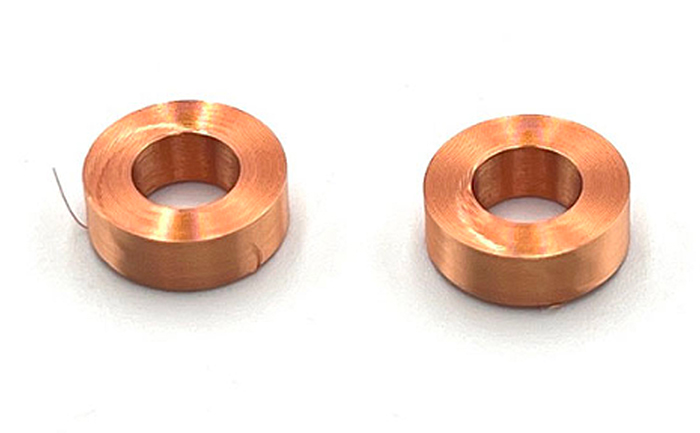
When custom-winding inductor coils, the following precautions should be observed:
Winding Method Selection
For air-core inductors, the winding method must align with circuit requirements, inductance value, and bobbin diameter.
Air-core coils are suitable for high-frequency (HF) and ultra-high-frequency (UHF) circuits. Coils with fewer than 3–5 turns achieve optimal performance without a bobbin, offering high Q factors (150–400) and stability.
Single-layer close-wound coils are ideal for shortwave and medium-wave circuits, providing Q factors of 150–250 and high stability.
Wire Selection
Use appropriately sized wire to ensure current-carrying capacity and mechanical strength.
Avoid overly thin wires, as they increase resistance, reduce Q factors, and risk burnout due to insufficient current capacity.
Terminal Markings
Coils with taps must have clear markings to simplify installation and maintenance.
Core Material Selection
Choose core materials based on operating frequency:
Audio-frequency coils: Silicon steel or permalloy cores.
Low-frequency coils: Ferrite cores (inductance up to several henrys).
HF circuits (e.g., AM radio): Ferrite cores with multi-strand insulated wire.
VHF/UHF circuits: Air-core or high-frequency ferrite cores. Single-strand silver-plated wire is preferred for HF.
100 MHz+ applications: Air-core coils or steel cores for fine-tuning.
PREV:Applications and Differences of Inductor Coil Magnetic Rings
NEXT:Common Coil Winding Characteristics and Application Scope





 Home
Home