
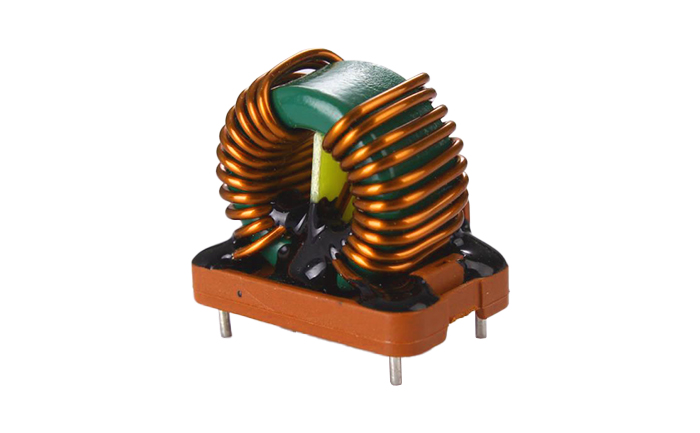
Inductor coils and magnetic rings have three primary applications: choke, filtering, and oscillation.
1. Choke
In low-frequency circuits, they block low-frequency alternating current (AC) and convert pulsating direct current (DC) into pure DC. They are commonly placed between two filter capacitors at the output of a rectifier circuit, forming a π-type filter with the capacitors.
In high-frequency circuits, they prevent high-frequency currents from flowing to low-frequency sections. For example, high-frequency chokes are used in vintage radios.
2. Filtering
Similar to choke functions, filtering blocks pulsating DC (after rectification) from entering pure DC circuits. A choke (or resistor for simplified designs) and capacitors (e.g., electrolytic capacitors) form a π-type filter. The capacitor’s charge/discharge action and the choke’s DC-blocking property smooth pulsating DC into stable DC.
3. Oscillation
Oscillation reverses rectification, converting DC back into AC. Circuits performing this are called oscillators. Oscillator waveforms include sine, sawtooth, trapezoidal, square, and spike waves, with frequencies ranging from Hz to GHz. They are widely used in wired/RF communication.
Key Concepts:
Inductance Definition: Inductance (L) is the ratio of magnetic flux (Φ) through a coil to the current (I) passing through it.
Inductor Behavior: Inductors oppose changes in current, generating voltage proportional to the rate of change.
Inductor Types:
Core Inductors: High inductance, used in filtering.
Air-Core Inductors: Low inductance, used in high-frequency circuits.
Magnetic Ring Inductors: Compact and efficient for power filtering and RF applications.
Applications:
Power Supplies: Chokes smooth rectified DC.
RF Circuits: Tuning and impedance matching.
Signal Processing: Filtering noise or generating specific waveforms.




 Home
Home